




How We Control Cavity-to-Cavity Consistency for Multi-Cavity Automotive Molds
For automotive injection molds, cavity-to-cavity consistency is non-negotiable. Automotive components demand strict dimensional control, stable assembly performance, consistent surface quality, and reliable long-run repeatability. Even minor variation between cavities can lead to fluctuating Cpk values, assembly mismatch, flash, short shots, and costly batch rejection — this is exactly the pain point many mold shops struggle with, where final inspection only catches defects after parts are molded, rather than locking uniformity into the mold build stage.
At Seaflyer Precision Industry, we build multi-cavity automotive molds with a systematic, cavity-by-cavity control strategy, covering design simulation, precision machining, assembly cross-checking, mold trial validation and production monitoring.
1. Balanced Runner & Gating Design + Moldflow Rheology Analysis
We start balance control at the DFM stage. For multi-cavity automotive tools, we adopt naturally balanced runner layout (H-type or radial layout) to ensure identical flow length, flow resistance and shear history from nozzle to each gate. We run Moldflow filling, packing, cooling and warpage simulation to predict melt front difference, pressure drop and temperature deviation across cavities. For hot runner molds, we configure independent zone temperature control for each nozzle to compensate thermal imbalance.
We avoid relying solely on machine parameters to fix inherent runner imbalance. Process adjustment is a fine-tuning tool, not a remedy for poor mold design.
2. Uniform Cooling System Design
Temperature difference between cavities is one of the biggest sources of dimensional variation. We design conformal cooling channels wherever possible, optimize water line spacing and distance to cavity surface, and use high-conductivity inserts for hot spots. Our target is tight temperature uniformity across all cavities. Uneven cooling creates inconsistent shrinkage and warpage, which directly breaks cavity-to-cavity consistency for PA66, PBT, PP-GF and other common automotive engineering plastics.
3. Precision Machining & Cavity Interchangeability Control
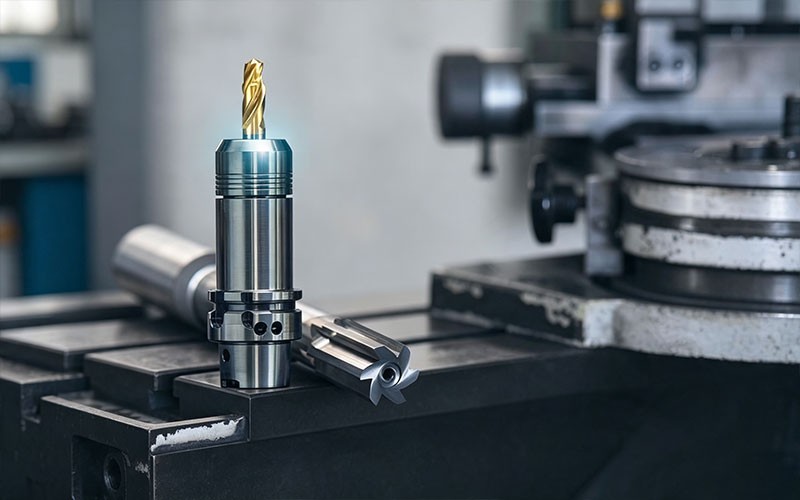
All cavity and core inserts are machined on high-precision CNC and EDM equipment with unified machining programs and strict tool management. Every single cavity insert is measured individually by CMM after machining, rather than only sampling. We control machining tolerances uniformly for gate size, vent depth, parting line and critical CTQ features.
Standardized insert manufacturing enables interchangeability; when one cavity suffers wear in mass production, replacement will not break the existing cavity balance.
4. Dual Check & Mutual Inspection Protocol (Our Core Control Against Hidden Variation)
This is our key practice to address the common blind spot: many teams inspect cavities one by one, but miss subtle cumulative deviation after full mold assembly. We implement a mandatory mutual cross-check procedure:
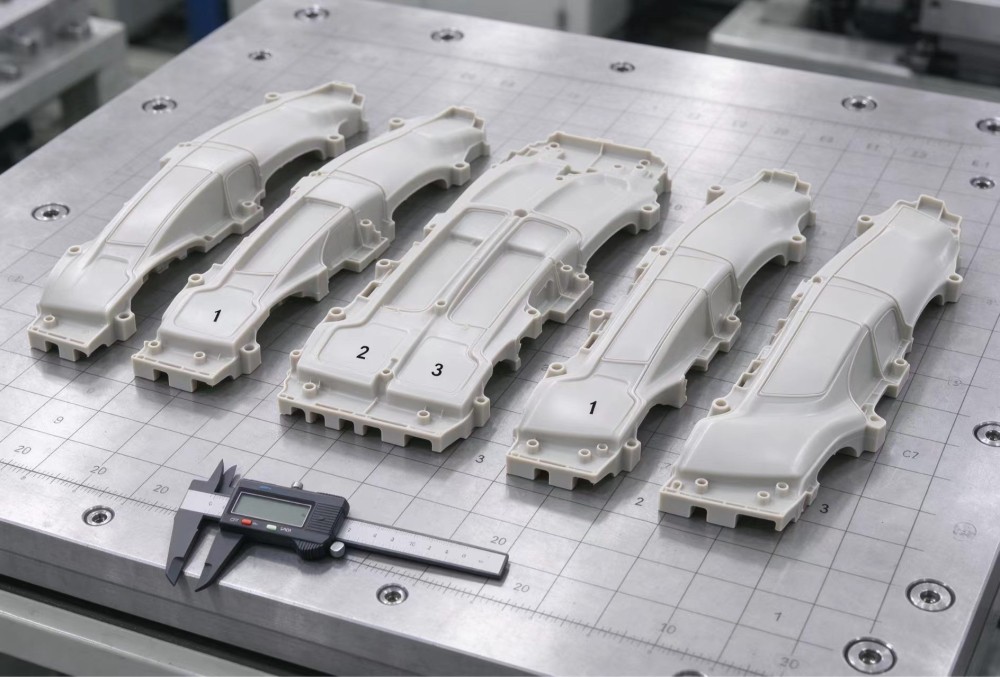
Each cavity is clearly marked with unique cavity ID.
Machinist finishes and self-inspects first; then a second senior mold maker independently verifies all critical dimensions, fit, gate, vent and alignment against the same drawing.
After mold assembly, we perform cavity-by-cavity comparison side by side, checking insert fitting, parting line flush, ejector pin height and vent condition.
All measured data is recorded per cavity, not averaged. Averaging hides outlier cavities and creates false pass results.
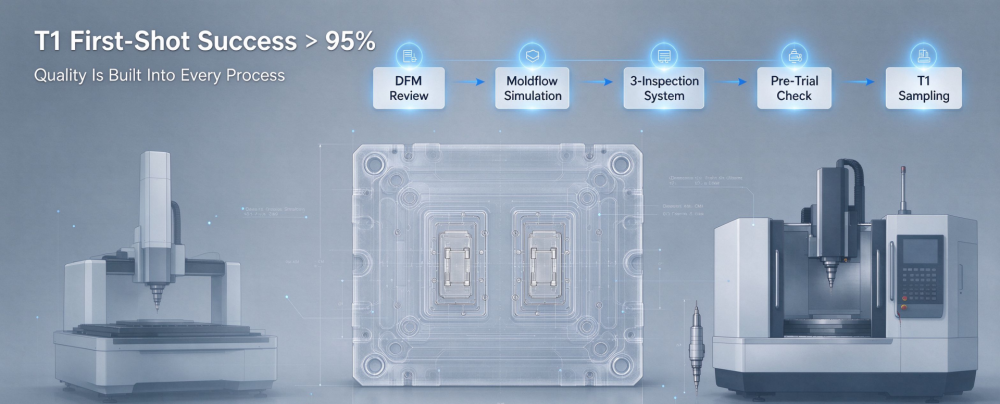
This mutual inspection catches tiny deviations before T1 trial, avoiding repeated trial-and-error and expensive rework.
5. Mold Trial: Cavity-Separate Sampling & Balance Validation
During mold trials, we collect samples tagged by cavity number from the same shot. We run short-shot balance test, part weight comparison, cavity pressure curve comparison and CMM measurement on CTQs for every cavity. We evaluate:
Synchronization of melt front
Weight deviation limit
Dimensional Cpk per cavity
Surface defect difference cavity by cavity
If one cavity behaves differently, we trace root cause back to gate, runner, cooling, venting or assembly fit, instead of adjusting global injection parameters to cover imbalance.
6. Long-Term Stability & Production Monitoring
After mold handover, we provide customers cavity-based inspection standards. In mass production, we recommend periodic cavity-split sampling, gate wear inspection and hot runner temperature calibration. As gates and vents wear over cycles, cavity balance drifts gradually; regular maintenance can restore consistency and extend mold service life.
Closing
For automotive multi-cavity molds, cavity-to-cavity consistency is not achieved by luck during molding. It is built layer by layer: balanced design, precise machining, rigorous mutual cross-check, cavity-isolated validation and standardized maintenance. This disciplined approach helps our automotive customers (Valeo, Mahle and other tier suppliers) hit stable Cpk, lower scrap rate and secure reliable high-volume production.
If you have a multi-cavity automotive mold project requiring tight cavity consistency, welcome to share your part requirements with our engineering team.
Related News
-
How We Control Cavity-to-Cavity Consistency for Multi-Cavity Automotive Molds
Company News | 2026.07.30Learn More
-
T1 First-Shot Success Rate Above 95%: It Does Not Happen by Chance
Company News | 2026.07.30Learn More
-

Automotive-Grade Three-Inspection System
Company News | 2026.07.30Learn More
-
Common Injection Molding Defects and Solutions
Industry News | 2026.07.30Learn More