




T1 First-Shot Success Rate Above 95%: It Does Not Happen by Chance
For automotive mold projects, everyone chases a smooth T1 trial. But many teams misunderstand what “good T1 result” means: they treat it as luck, or fix defects by continuous rework and on-site adjustment after the first shot. Repeated T1 delays push back your product launch schedule, consume extra rework budget, and even risk stopping your serial production line.
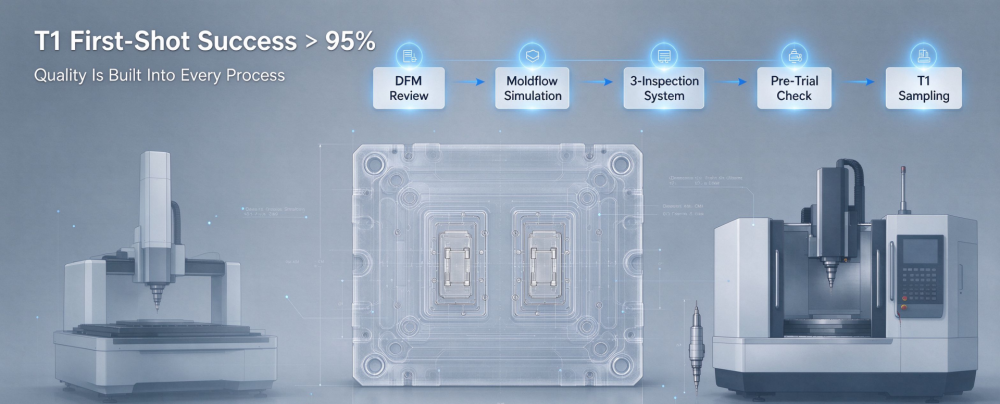
At Seaflyer, our stable T1 first-shot success rate above 95% is not a marketing slogan. It is the cumulative outcome of our automotive-grade three-inspection system, standardized DFM review, moldflow simulation and full-process risk control built for IATF 16949 automotive supply chain requirements.
What is our definition of a successful T1 first shot? It is not simply “plastic fills the cavity”. A qualified first-shot delivery means molded samples meet critical GD&T dimensions, cavity-to-cavity consistency, appearance specs, assembly requirements and material performance targets. Major root-cause defects such as severe sink marks, unrepairable weld-line weakness, air traps & burn marks, obvious warpage and ejection scuffing are avoided before machining starts.
The control starts long before CNC cutting. At the DFM stage, our engineering team reviews 3D data together with customers. We flag high-risk structures: uneven wall thickness, inadequate draft angle, poor venting layout, unbalanced gating and risky boss/rib designs. We propose feasible optimisation suggestions before steel is ordered. Moldflow simulation is deployed to predict shrinkage, warpage, melt front and pressure distribution, to avoid design traps that cannot be fixed only by tuning injection parameters.
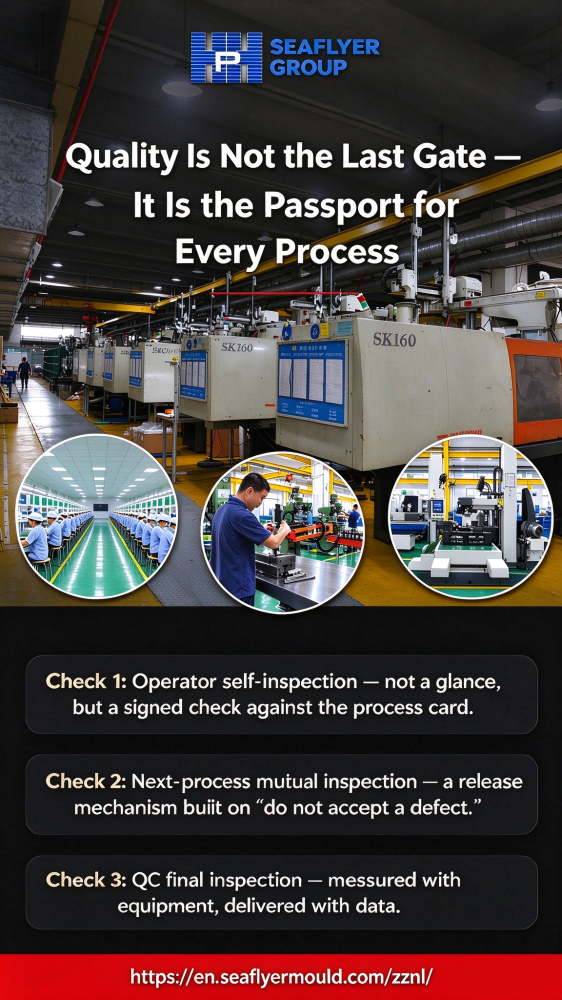
During mold manufacturing, the three-inspection framework acts as the safety net.
· Operator self-inspection locks in core dimensions, steel selection and process parameters at CNC, EDM, wire-cut and fitting stations.
· Inter-process mutual inspection stops non-conforming workpieces from flowing downstream, especially for multi-cavity molds where tiny cavity deviation multiplies quickly.
· QC final verification with CMM and 2D measuring equipment delivers traceable dimensional reports, FAI documents and CPK evaluation, confirming all machined features match customer drawings.
Even with solid design and precise machining, we still carry out pre-trial checks: hot runner temperature calibration, cooling circuit pressure & flow testing, slider and lifter movement verification, and vent slot validation. These pre-T1 checks eliminate assembly and utility issues on the bench, rather than discovering them on the injection machine.
We also need to clarify an important engineering boundary: not all molding defects can be fully eliminated by the mold. Some limitations come from plastic material anisotropy, fibre orientation or product structural constraints. Our responsibility is to control mold-related variables to the minimum, and inform customers of inherent risks at the earliest stage, so both sides set realistic expectations.
A high T1 first-shot success rate brings tangible value for automotive customers: fewer rework loops, shorter project lead time, predictable tooling budget and stable sample delivery for PPAP submission.
Quality is not corrected at T1. It is built into every design decision, every signed-off process step and every measured data point. If you have automotive, home appliance or medical precision mold projects for DFM assessment and quotation, send your 3D files to our technical team for evaluation.
Related News
-
T1 First-Shot Success Rate Above 95%: It Does Not Happen by Chance
Company News | 2026.07.30Learn More
-
Automotive-Grade Three-Inspection System
Company News | 2026.07.30Learn More
-
Common Injection Molding Defects and Solutions
Industry News | 2026.07.30Learn More
-
Five Core Technology Trends in Precision Mold Manufacturing
Industry News | 2026.07.30Learn More